
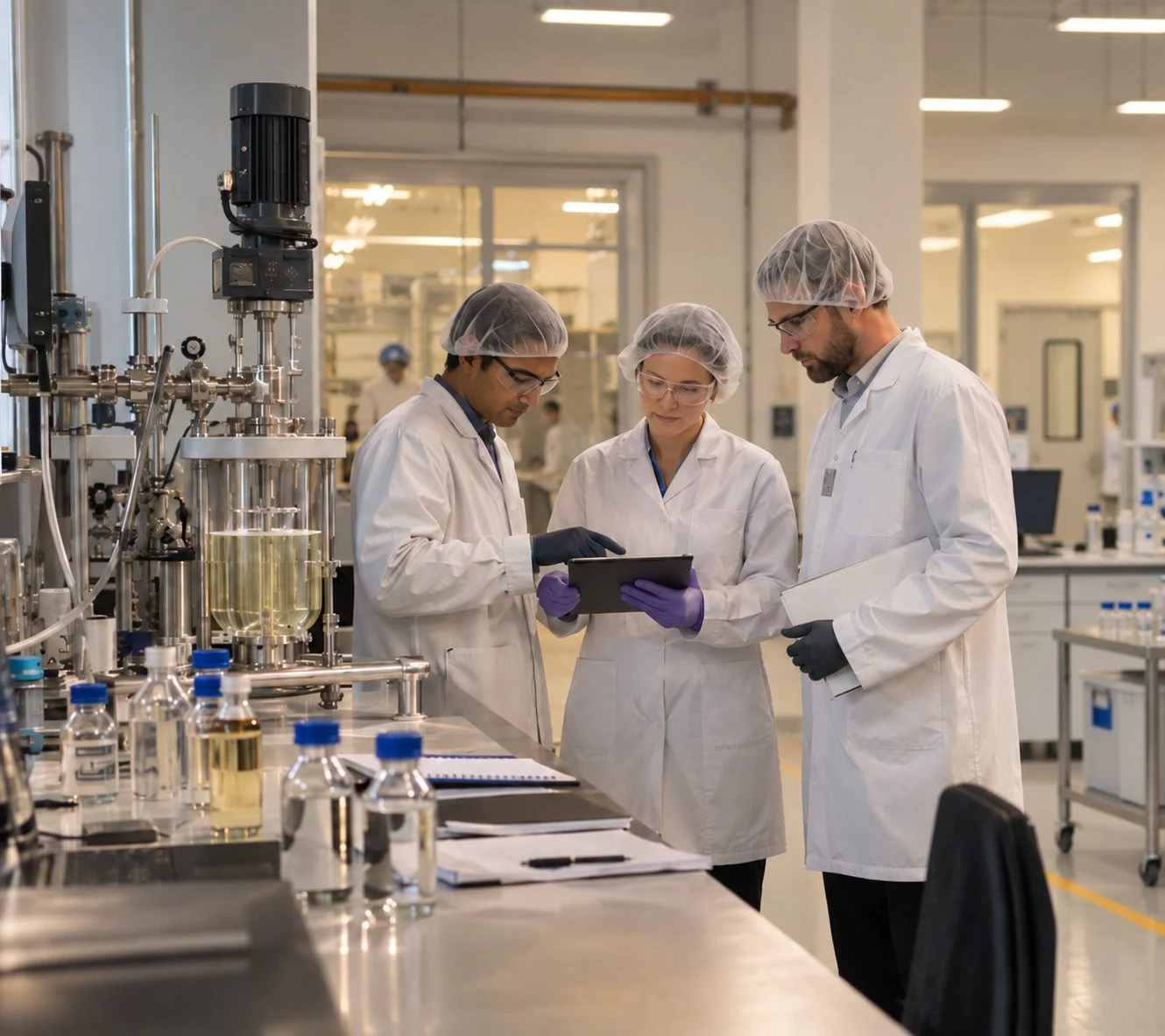
A formulation is only successful if it can scale
Laboratory success and repeatable production are different problems. Process engineering connects them — equipment, parameters, documentation and economics evaluated together.
Five scales, one process
Each step tests whether the formulation still behaves when the equipment, batch size and operators change.
-
Lab scale
Initial feasibility.
-
Development scale
Evaluate formulation and processing variables.
-
Pilot scale
Evaluate translation to larger equipment.
-
Clinical supply scale
Where appropriate, manufacture or coordinate appropriately authorized clinical-study material under the applicable legal framework.
-
Production scale
Establish repeatable processing parameters and controls.
Twenty variables under control
Capabilities may include evaluation and optimization of:
- Batch-size evaluation
- Equipment selection
- Mixing order
- Addition sequence
- Mixing speed
- Mixing time
- Shear
- Temperature
- Vacuum requirements
- Milling
- Sieving
- Homogenization
- Compression
- Flow characteristics
- Hold times
- Transfer methods
- Yield optimization
- Cleaning considerations
- Packaging speed
- Operator requirements
A catalogue of known failure modes
Potential problems include:
- Sticking
- Capping
- Picking
- Lamination
- Cracking
- Weight variation
- Poor powder flow
- Segregation
- Potency variation
- Low yield
- Friability
- Long disintegration
- Poor taste
- Sedimentation
- Phase separation
- Color change
- Odor
- Crystal formation
- Precipitation
- Packaging problems
- Excessive moisture
- Heat degradation
Engineering the process, then the economics
Potential services:
- Process mapping
- Critical process parameter identification
- Bottleneck analysis
- Batch cycle-time analysis
- Yield improvement
- Waste reduction
- Changeover reduction
- Cleaning optimization
- Labor optimization
- Equipment utilization
- Production balancing
- Workflow optimization
- Material flow
- Personnel flow
- Capacity modeling
Evaluate
- Can it be repeatedly manufactured?
- What labor is required?
- What equipment?
- What throughput?
- What failure modes?
- Is cleaning difficult?
- Is packaging compatible?
- Is the product economically viable?
- Expected yield?
- Required testing?
- Material availability?
- Clinical evidence requirements?
Every input lands in the same equation
Thirteen cost inputs are modeled together so the economics are visible before scale-up decisions are made.
Model inputs
- API
- Excipient
- Flavor system
- Packaging
- Analytical testing
- Clinical-development expense
- Direct labor
- Equipment utilization
- Yield loss
- Waste
- Shipping
- Quality burden
- Batch size
Modeled together
Cost per dispensed unit
Total development cost to launch
Move knowledge, not just formulas
Potential services:
Development knowledge
What the development team learned about the formulation and its process window.
Documented process
Records, specifications and parameters written so the process can be repeated.
Receiving environment
Qualification support, training and troubleshooting at the site that takes it on.
- Formula transfer
- Master formulation records
- Batch records
- Process instructions
- Equipment equivalency
- Analytical methods
- Material specifications
- Packaging specifications
- Critical parameters
- Training
- Troubleshooting
- Change-control support
- Receiving-site qualification support